Developing Innovating Solutions to Kansas Lakes
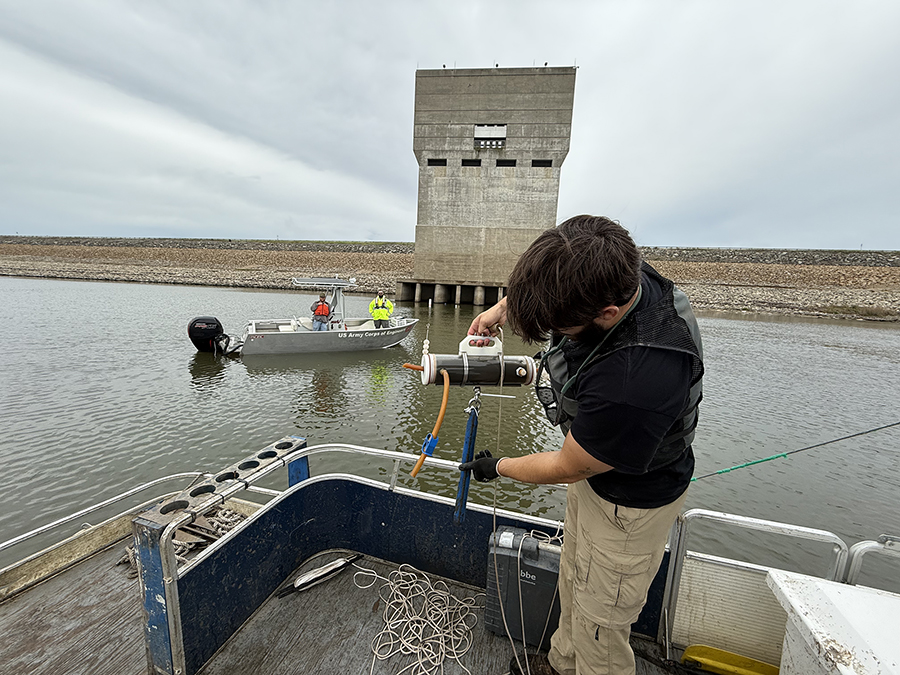
A vital reservoir that provides drinking water and flood control for more than 40 percent of Kansans is the site where KU researchers are testing a novel approach to deal with sediment buildup.
The project — hosted at Tuttle Creek Lake, near Manhattan, Kansas — is a U.S. Army Corps of Engineers effort jointly-funded by the U.S. Army Corps of Engineers and Kansas Water Office.
It marks the first time that a water injection dredge has been used in a lake to remove sediment, which accumulates over time in lakes, reducing the amount of water they can store. The U.S. Army Corps of Engineers estimates that without intentional action, Tuttle Creek Lake will be 75% full of sediment by 2074.
“Traditional hydraulic dredging is like a chainsaw attached to a wet-dry vacuum. Sediment is suctioned from the bed, pumped through miles of pipelines and discharged onto the land in a confined disposal facility — which is all very expensive,” said John Shelley, associate research professor in the Department of Civil, Environmental and Architectural Engineering who is one of the lead researchers on the project.
For instance, a traditional hydraulic dredging project conducted 10 years ago at nearby John Redmond Reservoir cost $20 million. At current prices and scaled to the size of Tuttle Creek Lake, the price tag for a similar project would exceed $67 million per year, just to keep pace with the annual rate of sediment accumulation.
Water injection dredging works differently. In this process, lake water is injected into the reservoir sediment, which creates an underwater slurry that flows toward the dam. From there, it is released through discharge gates in amounts natural for the watershed.
Shelley said water injection dredging could be much more cost effective than traditional dredging because it eliminates expensive pipelines, does not require additional land for disposal and rather than pumping a sediment slurry thousands of feet, clear water is pumped only a few dozen feet from the dredge to the reservoir bottom.
"We know we have to address this issue. If the sediment is not managed, our lakes fill with mud and we won’t have enough water during times of drought,” Shelley said.
Water injection dredging may not be suitable for every lake in Kansas, but Shelley said thus far, the project at Tuttle Creek is showing promising results.
“This project is just a demonstration, but our preliminary measurements show this process works well enough that it’s more productive and far more cost effective than traditional methods,” Shelley said.
Shelley joins Tony Layzell, associate scientist at the Kansas Geological Survey; and Ted Harris, associate research professor at the Kansas Biological Survey & Center for Ecological Research, as the KU researchers involved in the project.
Shelley’s role has included coordinating data collection strategies amongst a larger group of researchers from KU and other partner organizations, including Kansas State University, Virginia Tech University, the U.S. Bureau of Reclamation and the University of Delft in the Netherlands. These research efforts complement extensive monitoring conducted by the US Army Corps of Engineers.
The U.S. Army Corps of Engineers completed the first two rounds of dredging in fall 2025 and spring 2026. A third round is planned for summer 2026. The results of the KU research studies are anticipated to be published in late 2026 or early 2027.