KU researcher’s work contributes to data transmission link from Artemis II mission
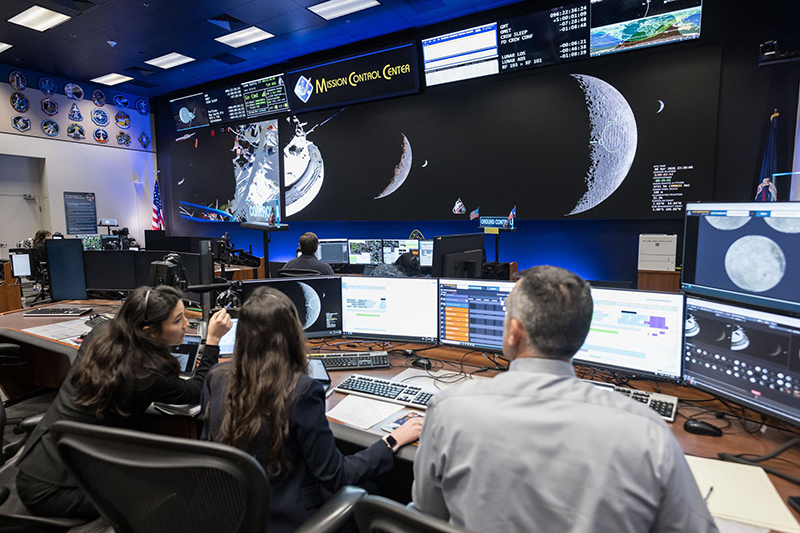
LAWRENCE — The Artemis II Mission marked the farthest humans have traveled from Earth and could pave the way for future crewed lunar missions and deep space travel.
As humanity ventures into deep space, the need for highly reliable data transmission links over long distances becomes critical.
Through the work of University of Kansas researcher Erik Perrins, observers on Earth during the April mission were able to receive high-bandwidth transmissions from the Orion capsule, such as video and audio feeds, without being corrupted by errors.
“The technology we added to the communication system is a game-changer because it allows the spacecraft to send down larger bursts of data even when the signal becomes very weak,” said Perrins, University Distinguished Professor of Electrical Engineering & Computer Science.
Wirelessly sending and receiving data over extremely long distances is a challenge, because signals degrade during transmission. To reduce errors in received signals, a series of extra or redundant digits, known as bits, can be added to a transmission to detect and correct errors.
Perrins’ work contributed to NASA’s ability to reliably receive and transmit data during the recent Artemis II mission.
His research centers on a powerful type of error coding known as a low-density parity check, or LDPC. He describes the basic idea of error coding with an example where the message “0” is encoded as “000” and “1” is encoded as “111.”
“If the message ‘101’ is received, we recognize that an error has occurred and the most likely intended message was a 1,” he said. “In this example, we gain the ability to correct one error in transmission, but we have tripled the number of bits that must be transmitted.”
Communication systems have limited bandwidth, and minimizing additional data transmitted without sacrificing reliability is important. Bandwidth is often explained using the analogy of a highway — where a higher number of lanes represents a larger bandwidth, and cars driving along those lanes represent data being transmitted. If less lanes of this bandwidth-highway are needed for error-checking and redundancy, more bandwidth is available for data transmission.
In 2005, Perrins received a research grant to add error control coding technology to telemetry standards to improve data reliability and power efficiency. Perrins studied codes that could improve efficiency up to a factor of 10 by doubling the transmitted bandwidth. Ten years later, his effort paid off.
"Our final recommendation was a powerful type of coding known as a low-density parity check (LDPC) code, and in 2015, LDPC codes were adopted into the international telemetry standard,” Perrins said.
These advancements have a wide range of applications in long-range data transmission, specifically in space exploration.
“LDPC codes are particularly beneficial for NASA’s telemetry downlinks because of the tremendous distances involved,” Perrins said.
John Waterfield serves as the range chief engineer at NASA’s Wallops Flight Facility in Wallops Island, Virginia. He provides technical oversight for all range-related operations and engineering projects. He said for rocket launches, it is critical to maximize the distance that signals can be reliably transmitted.
“With the introduction of LDPC, we are able to receive data reliably over very long distances at extremely low signal‑to‑noise ratios,” Waterfield said.
These advances in the LDPC codes directly influence deep-space exploration because accurate telemetry data contributes to enhanced scientific return and crew safety.
“Compared with earlier missions — including Shuttle‑era and initial SLS development — Artemis II enjoyed improved link margins during critical phases of flight, higher telemetry reliability and greater flexibility in ground‑station support planning since LDPC enables more efficient use of antenna resources and offers operational ‘breathing room’ not previously achievable.”
The impact of Perrins’ work on LDPC codes is a step forward in humanity’s push to expand space exploration, which requires continual development of technology capable of supporting deeper, longer and more advanced missions. Looking to the future, Perrins said there is still more research to be done with LDPC technology.
“Now that this technology has been proven in the telemetry industry, we are hoping to conduct additional research to provide a comprehensive LDPC solution for all telemetry modes,” he said.
Perrins also makes a nod to the past, noting that KU has long been a leader in this field.
“KU’s strength in wireless communications and networking goes all the way back to the 1970s and is one of the reasons I joined KU back in 2005.”